CyberDNA Center
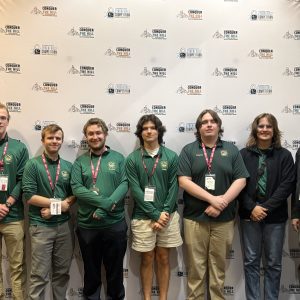
Impressive Finish by 49th Security Division
The University of North Carolina at Charlotte’s 49th Security Division Team achieved an impressive 19th place finish out of 100 teams in the prestigious U.S. Department of Energy (DOE) CyberForce Competition, a nationwide challenge that tests students’ cybersecurity skills in defending critical infrastructure from simulated cyberattacks, held in Tinley Park, Illinois on November 15, 2025. […]
From Residual Faults to Zero-Day Software Vulnerabilities: A Characterization Study
Domenico Cotroneo Department of Computer Science UNC Charlotte Nov 12 2025 11:30 WWH 335 Zero-day vulnerabilities and residual software faults share a common characteristic: both escape detection during development and testing, yet represent critical threats to software security and reliability. While residual faults remain hidden until triggered in the field, zero-day vulnerabilities are unknown to vendors […]
Agentic AI for Critical Infrastructure Security
Dylan Christensen Nov 5th 2025 11:30 WWH 335 Abstract: The security and reliability of our critical infrastructure is increasingly dependent on the integrity of millions of interconnected Cyber-Physical Systems (CPS) and IoT devices. UNCC’s Center for Energy Security and Reliability (CESAR) addresses this challenge by demonstrating vulnerability discovery through emulating threat actor approaches on components […]
Formal robustness for Cyber-Physical Systems under Sensor Attacks
Oct 29 11:30-12:30. WWH 335 Jian Xiang Department of Software and Information Systems Abstract: Cyber-physical systems, such as autonomous vehicles, must defend against attacks that target sensor hardware. Analyzing system design can help system engineers understand how a compromised sensor could impact the system’s behavior; however, developing security guarantees, especially formal guarantees, for cyber-physical systems is […]
Understanding and Mitigating SMiShing Vulnerability: Insights from U.S. Surveys and Interviews
Oct 8th 11:30-12:30 WWH 335 Cori Faklaris Department of Software and Information Systems UNC Charlotte Abstract: As mobile phone usage continues to rise, so do scams targeting these devices. SMiShing, or SMS phishing, involves fraudsters sending phishing links via text messages. Despite its growing prevalence, little is known about who is most vulnerable to these […]
Towards Automated and Explainable Cyber Threat Hunting Leveraging Generative AI
Bill Chu Department of Software and Information Systems UNC Charlotte Wed Sept 24, 11:30-12:30 WWH 335 ABSTRACT We attempt to automate parts of threat hunting, taking cyber threat intelligence messages as input and generating queries to search logs for attack evidence using a popular query language used in Security Operations Centers (SOC). Our prototype uses […]
26th Annual UNC Charlotte Cybersecurity Symposium, 2025
Event Date: September 30, 2025 (All day) to October 1, 2025 (All day) Location:Presented on Campus Overview: Cybersecurity is a top-of-mind concern for businesses of all sizes. This symposium will continue our tradition of bringing world-class speakers to discuss cutting-edge security issues and best practices for businesses to mitigate security risks.
Securing the Software Supply Chain by Solving the Lemons Market
L Jean CampProfessor of Informatics and Computer ScienceLuddy School of Informatics, Computing, and EngineeringIndiana University. April 17 11am. WWH 335 The Software Bill of Materials (SBOM) is a list of components that can be used to identify any documented vulnerability associated with the enumerated dependencies. Analogies have been made to safety, as with materials safety […]
FutureG Wireless Security: Challenges and Opportunities
Yanchao Zhang Professor in the School of Electrical, Computer and Energy Engineering at Arizona State University (ASU). April 10th 10-11 WWH335 As wireless networks evolve toward FutureG—encompassing 6G and beyond—theypromise transformative capabilities through ultra-high-speed connectivity, ultra-densedeployments, AI-native architectures, and the convergence of sensing, communication,and computation. These advancements are expected to enable a wide range ofmission-critical applications across […]
PEPPER: Privacy-prEserving, auditable, and fair Payment based resource discovery at the PERvasive edge
Dr. Satyajayant Misra, Department of Computer Science, New Mexico State University. April 7th 2-3pm. WWH 335 Pervasive Edge Computing (PEC), a recent addition to the edge computing paradigm, leverages the computing resources of end-user devices to execute computation tasks in close proximity to end users. One of the primary challenges in the PEC environment is […]